
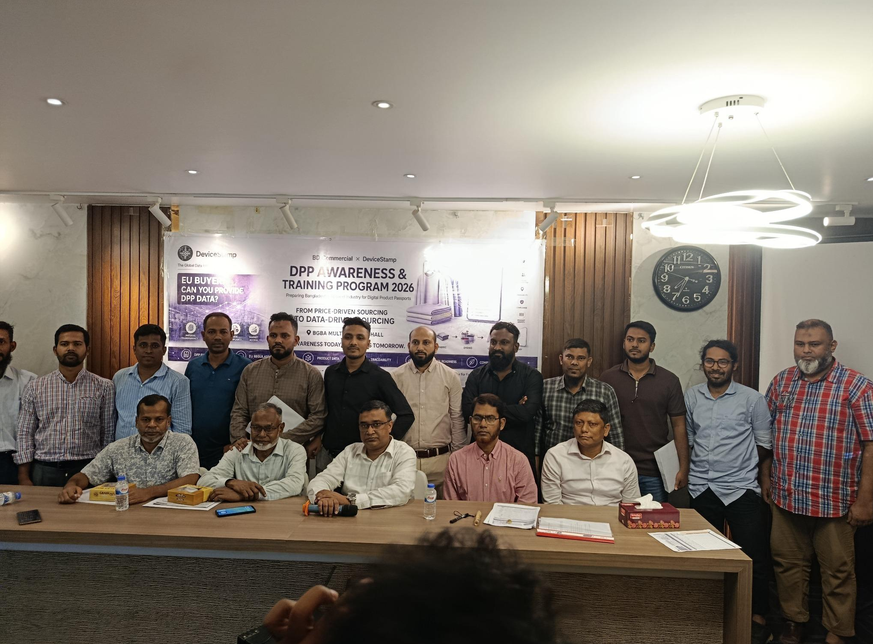
83 Leading Manufacturers Join DeviceStamp's DPP Awareness and Training Programme in Dhaka
DeviceStamp's first DPP awareness and training programme in Bangladesh connected international expertise with the operational realities of the country's apparel industry.
On 7 August 2026, DeviceStamp, in association with BD Commercial, delivered the DPP Awareness & Training Programme 2026 at the BGBA Multipurpose Hall in Uttara, Dhaka.
The programme was the first structured DeviceStamp initiative in Bangladesh designed specifically for apparel commercial professionals. It brought together industry participants to examine what the European Union's Digital Product Passport means for manufacturers, why product-data readiness matters and how factories can begin preparing in practical terms.
Interest was strong and 83 manufacturers attended with representatives. Participants remained through the full programme, contributing practical questions and sharing concerns about how DPP requirements could be coordinated across real factory operations.
The event marked an important starting point: moving the DPP conversation in Bangladesh from general awareness toward departmental responsibility, structured evidence and implementation readiness.
Why DeviceStamp Began with Commercial Professionals
DeviceStamp intentionally began with the commercial community.
Commercial professionals operate at the point where buyer expectations become factory action. They interpret customer requirements, coordinate product and supplier information, manage compliance and shipment documentation, and connect management, merchandising, sourcing, production, compliance and international buyers.
This position makes the commercial function especially important in the transition toward Digital Product Passports.
In today's workflow, commercial teams often collect and exchange documents. In a DPP environment, their role will increasingly involve helping transform information held across the factory into structured, connected and verifiable product evidence.
That evidence may include product identity, material composition, manufacturing information, supplier records, testing results, traceability data, sustainability information and compliance documentation. No single department creates all of it. Readiness depends on coordination.
Commercial professionals therefore should not be viewed only as a support function in DPP preparation. They are positioned to become a critical readiness function - connecting what buyers request with the information factories and suppliers can provide.
Connecting Global Context with Bangladesh's Factory Reality
The programme combined international DPP knowledge with practical apparel-industry experience from Bangladesh.
Björn Johannes Eriksson, CEO of DeviceStamp, provided strategic direction and the global DPP perspective. His contribution placed Bangladesh within a broader transformation in which product information, traceability, and evidence are becoming increasingly important across international value chains.
Paulina Kruk contributed an international and buyer-facing perspective, herself with a background in several EU brands, explaining why European brands are preparing for DPP and why manufacturers should understand the direction of travel before new data requests become urgent.
Leading the main awareness and training sessions was Nazrul Islam, Director of DeviceStamp Bangladesh and the DPP Awareness & Industry Training Lead for Bangladesh. His sessions focused on DPP fundamentals, buyer expectations, business risk, product-data architecture, supplier evidence, traceability and factory readiness.
Matias Marti, CTO of DeviceStamp, presented the DeviceStamp web platform and demonstrated the journey from factory information to Digital Product Passport access, including the role of digital infrastructure and QR-based product access.
Together, these contributions connected three levels of the transition: the international direction, the buyer perspective and the practical work required inside factories.
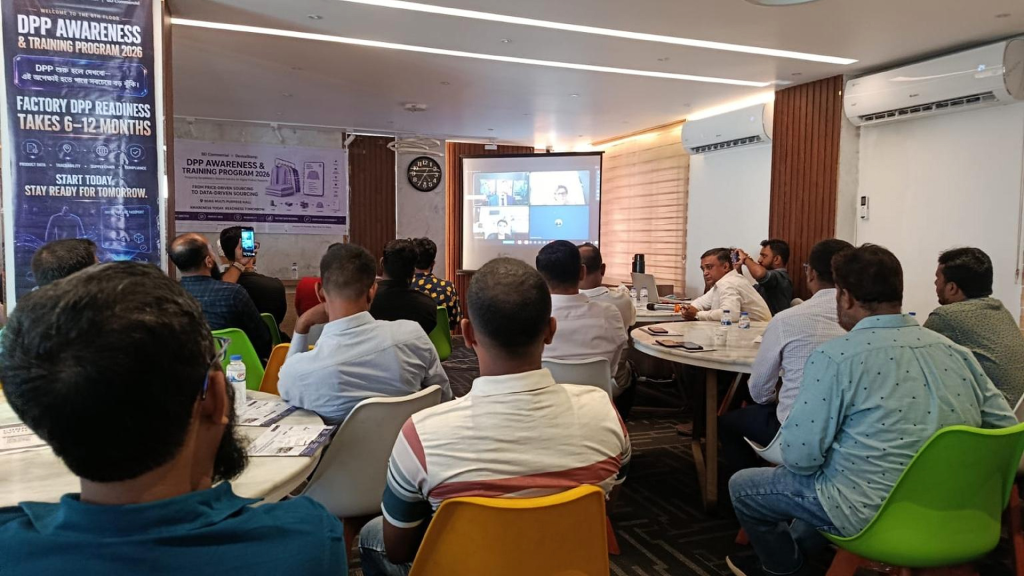
A Digital Product Passport Is More Than a QR Code
One message remained clear throughout the programme:
A Digital Product Passport is much more than a QR code.
A QR code can provide an access point, but it does not create credible product evidence on its own. The reliability of a DPP depends on the information connected behind it.
For apparel manufacturers, this can involve several categories of information:
- Product and manufacturer identity
- Fibre, material and component information
- Manufacturing and process records
- Supplier and supply-chain visibility
- Testing and compliance evidence
- Environmental and sustainability information
- Durability, care, repair and circularity information
The challenge is not simply to display these fields. Factories need to understand where the information originates, which department owns it, how it is updated, which supporting evidence exists and how it can be connected to the correct product.
This is why DPP readiness is an organisational question as much as a technical one.
From Documents to Connected Product Evidence
Apparel factories already manage large volumes of information. Merchandising teams hold style and buyer requirements. Commercial teams manage order and shipment documentation. Sourcing teams work with material and supplier records. Compliance teams maintain certificates and audit evidence. Production and quality teams create process, inspection and testing records.
Much of the information that may support future DPP workflows therefore already exists. The difficulty is that it may be distributed across departments, spreadsheets, emails, certificates, portals and paper files.
The programme encouraged participants to look beyond the number of documents a factory holds and consider the quality of the underlying data flow:
- Can information be connected to the correct product?
- Is its source clear?
- Is responsibility assigned?
- Can a claim be supported by evidence?
- Can the information be updated when a material or supplier changes?
- Can it be shared efficiently when an authorised buyer requests it?
Moving from documents to product evidence requires factories to organise information so that it is structured, traceable and reusable - not rebuilt from the beginning for every request.
The Industry Asked a Practical Question: Where Do We Start?
Participant engagement remained strong throughout the session. The questions also revealed an important implementation challenge.
For many professionals, the technical scope of DPP can initially appear complex. Participants wanted a clearer entry point: what should a factory do first, what information should be collected at each stage, which department should provide it, and how should responsibilities be divided?
This was one of the programme's most valuable outcomes.
The industry's response showed that awareness alone is not enough. Factories need a simplified and factory-oriented pathway that translates the DPP concept into manageable operational tasks.
Based on the discussion, four needs emerged:
- A clear starting point - factories need to know which product or dataset to examine first.
- Minimum data requirements - teams need a practical view of the essential information before expanding into more advanced fields.
- Role-based responsibility - merchandising, commercial, sourcing, production, compliance, sustainability and IT need clearly defined contributions.
- A phased readiness model - preparation should progress through understandable stages rather than appear as one large technical transformation.
This feedback will help DeviceStamp refine future learning materials, factory assessments and implementation support. The goal is to make DPP readiness actionable without oversimplifying the evidence and coordination it requires.
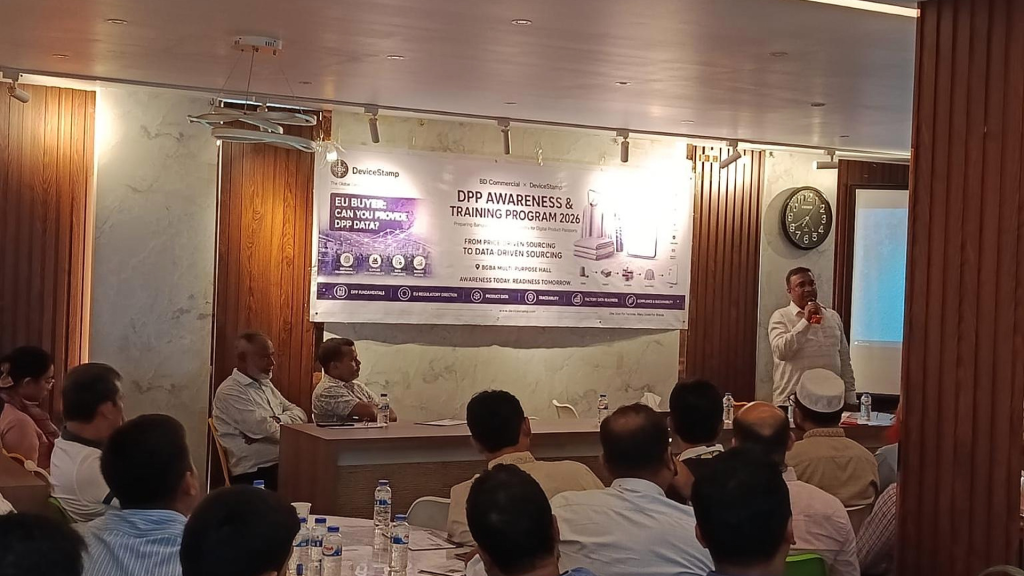
Readiness Is a Process, Not a Last-Minute Submission
One of the programme's central lessons was that DPP preparation should not begin when a buyer sends an urgent request.
Supplier mapping, data cleaning, evidence review and departmental coordination take time. External suppliers and subcontractors may also need to provide information in a clearer and more consistent form.
A factory can begin without attempting to transform every product at once. A practical first step is to select one product and map:
- The relevant product and purchase-order information
- Its materials and components
- The suppliers connected to those materials
- Available test reports and certificates
- Production and compliance records
- The department or role responsible for each item
- Missing, duplicated, or difficult-to-verify information
This creates a visible starting point. It also helps the factory understand whether the main challenge is missing information, inconsistent naming, weak supplier evidence, unclear ownership, or inefficient retrieval.
Readiness grows when these findings are turned into repeatable workflows.
Strong Participation Signals Readiness to Learn
The programme's strong attendance rate, full-session participation and continued engagement after the event demonstrated meaningful industry interest.
Participants contributed questions during the programme and later expressed support through the event's communication group and direct conversations. Pre-event coverage appeared in three newspapers, followed by additional post-event reporting and photographs, extending the DPP readiness discussion beyond the room.
The strongest signal, however, was not attendance alone. It was the nature of the questions.
Participants were not only asking what a Digital Product Passport is. They were asking how factories should organise the work, where data should enter the process, and who should be responsible.
That shift - from definition to implementation - is where readiness begins.
What Comes Next
The DPP Awareness & Training Program 2026 was designed as a starting point, not a standalone event.
DeviceStamp's next stage of engagement is expected to include:
- Additional learning programmes for apparel commercial professionals
- A dedicated awareness programme for BGBA members
- Executive readiness sessions for garment owners and factory leadership
- More practical role-based and departmental guidance
- Advanced DPP learning and readiness assessment
- Factory-level implementation and pilot support
The next phase will place greater emphasis on simplified workflows, practical examples, minimum data requirements and clear responsibility across factory functions.
From Price-Driven Sourcing to Data-Driven Sourcing
Bangladesh's apparel industry has built its global position through manufacturing capability, commercial experience and the ability to respond to changing buyer expectations.
The next transition will require factories to strengthen not only the product they deliver, but also the information and evidence connected to that product.
Price, quality, capacity and delivery will remain central to sourcing. Data readiness adds another dimension: the ability to provide reliable product and supply-chain information with clarity, consistency and control.
DeviceStamp is working to make that transition practical - connecting international DPP knowledge with factory workflows, supplier evidence and the realities of Bangladesh's apparel sector.
The journey has begun with awareness. The next step is turning that awareness into structured preparation and implementation.
Awareness Today. Readiness Tomorrow.
Media Coverage
The DPP Awareness & Training Program received coverage from Bangladeshi news outlets:
- DeviceStamp Holds DPP Training for Bangladesh's RMG Industry - Business Times
- পোশাক শিল্পের জন্য ডিভাইসস্ট্যাম্পের DPP প্রশিক্ষণ - BD Bulletin (Bangla)