
Furniture
Industry guide to Digital Product Passports for furniture. Materials and components, supplier data, product composition, origin and traceability, documentation, and DPP readiness.
Furniture
Digital Product Passports for Furniture
Connect material, supplier and product data across complex furniture value chains.
Industry News & DPP




Executive Brief
What Decision-Makers Need to Know
A single piece of furniture can combine wood and panels, textiles and leather, metals, plastics, glass, adhesives and finishes — sourced from many independent suppliers across multiple tiers. That makes structured product data especially important: composition, origin, and supplier information must come together into one coherent product record. Organisations that start structuring this data early are better placed for Digital Product Passport readiness, whatever the final product-specific rules look like.
| Area | Summary |
|---|---|
| Regulatory driver | EU Ecodesign for Sustainable Products Regulation (ESPR), entered into force 2024; product-specific requirements are defined through delegated acts |
| Sector focus | Product-data readiness for furniture — multi-material, component-heavy products with multi-tier supply chains |
| Core challenge | Fragmented supply chains where material, component and supplier data lives in disconnected systems |
| Primary requirement | Structured, interoperable product data across the full value chain |
| Key standards | GS1 Digital Link, GTIN, GLN, EPCIS, UN/CEFACT |
| Critical bottleneck | Supplier-side onboarding, identity infrastructure, and upstream traceability |
| Urgency signal | Multi-year infrastructure transition — preparatory work cannot wait for final rules |
Furniture Value Chain
Raw Materials to Reuse — Every Stage Generates DPP-Relevant Data
Each stage of the value chain creates product identity data, transformation records, compliance information, material composition data, process events, and chain-of-custody relationships. Because furniture products bring together many components from different suppliers, the core implementation challenge is preserving identity relationships from raw materials through components to the finished product.
Raw Materials
Furniture production draws on solid wood and panels, textiles and leather, metals, plastics, glass, foams, adhesives, and coatings. Relevant DPP data includes material composition, origin, recycled content, certifications, and chemical inputs. Upstream visibility is difficult because these inputs frequently move through traders and intermediaries before reaching component manufacturers or factories.
Component Manufacturing
Frames, panels, boards, mechanisms, castors, hinges, covers, and fasteners are often produced by specialised suppliers — sometimes several tiers away from the brand. Each component contributes to the finished product's record, so component-level batch references, composition data, and supplier information need to stay linked to product identity rather than living in isolated spreadsheets or PDFs.
Finishing & Assembly
Assembly and finishing operations are typically where DPP identity becomes physically attached to the product through QR labels, NFC tags, serialised barcodes, or GS1 Digital Link identifiers. Critical tasks include applying the data carrier, linking it to manufacturing records, and keeping product identity synchronised with the correct material and component data — most factories manage some production data already, and the challenge is connecting those systems to passport workflows in a standardised way.
Distribution & Retail
Furniture moves through wholesale, retail, e-commerce, and increasingly flat-pack and marketplace channels. DPP systems may support consumer access, compliance verification, and authenticity checks at the point of sale, while giving brands and authorities access to different layers of the same product record.
Use, Repair & Lifecycle Data
Furniture has long use phases, which makes repairability, spare parts, care, and disassembly information especially relevant. Structured lifecycle data can support repair guidance, spare-part identification, and refurbishment workflows — turning the passport into a practical tool across years of product use, not just a compliance record.
Reuse & End-of-Life
At end-of-life, DPP data may support resale authentication, refurbishment, disassembly guidance, material identification, and recycling. Furniture combines materials that are difficult to separate — which is exactly why structured composition and treatment data matters: without it, material recovery and circularity claims are hard to verify.
Why Furniture DPP Is Operationally Difficult
Six Structural Challenges
Multi-Material Products
A single chair or sofa can combine wood, panels, textiles, foams, metals, plastics, and finishes — each with its own suppliers, batches, and documentation. Connected product data is what turns these separate records into a coherent product-level picture.
Multi-Tier Supply Chains
Materials, components, and assembly often come from different countries and different tiers of suppliers. This creates fragmented accountability, inconsistent identifiers, and limited visibility beyond Tier 1 — precisely where much of the DPP-relevant data originates.
Component-Level Identity
Future DPP systems will require decisions about when identity is tracked at item, component, batch, or product-model level — and consistent management of those relationships. If component batches are not linked to finished products during assembly, upstream claims about materials or origin become difficult to verify later.
Non-Standard Data Structures
Critical production data exists in incompatible formats across ERP systems, spreadsheets, PDFs, manual logs, PLM exports, and certification files. Standardising this information into structured, machine-readable product data is a major interoperability challenge that no single vendor can solve alone.
QR, NFC & RFID Deployment
Factories must integrate physical tagging into live manufacturing operations — label printing, serialisation, scan verification, production-line integration, and packaging workflows. Carrier placement and durability also matter for products that are transported, assembled, and used for years, which is why technology-neutral implementation is important.
Data Sovereignty & Access Control
DPP systems must balance regulatory transparency, commercial confidentiality, and consumer access. Consumers receive composition, care, and repair information; brands need compliance and supplier records; authorities may require broader access. Access-control models are therefore a strategic design decision, not an afterthought.
Why Supplier-Side Infrastructure Matters
The DPP Problem Is Upstream, Not Consumer-Facing
Most DPP discussions focus on consumer interfaces and brand portals. In practice, DPP data originates upstream across fragmented supplier ecosystems — sawmills and panel producers, textile and foam suppliers, hardware and mechanism manufacturers, assembly factories, logistics operators, and certification bodies. This creates a structural interoperability challenge: repeated supplier onboarding, incompatible schemas, inconsistent identifiers, and limited visibility beyond Tier 1.
What Supplier-Side Infrastructure Enables
- Reusable onboarding workflows across multiple brands and platforms
- Interoperable data exchange between disconnected production systems
- Shared identity frameworks for materials, components, and facilities
- Normalised supplier data without duplicated integrations
- Scalable traceability operations across global supply bases
- Controlled data access for downstream systems and regulators
The SME Problem
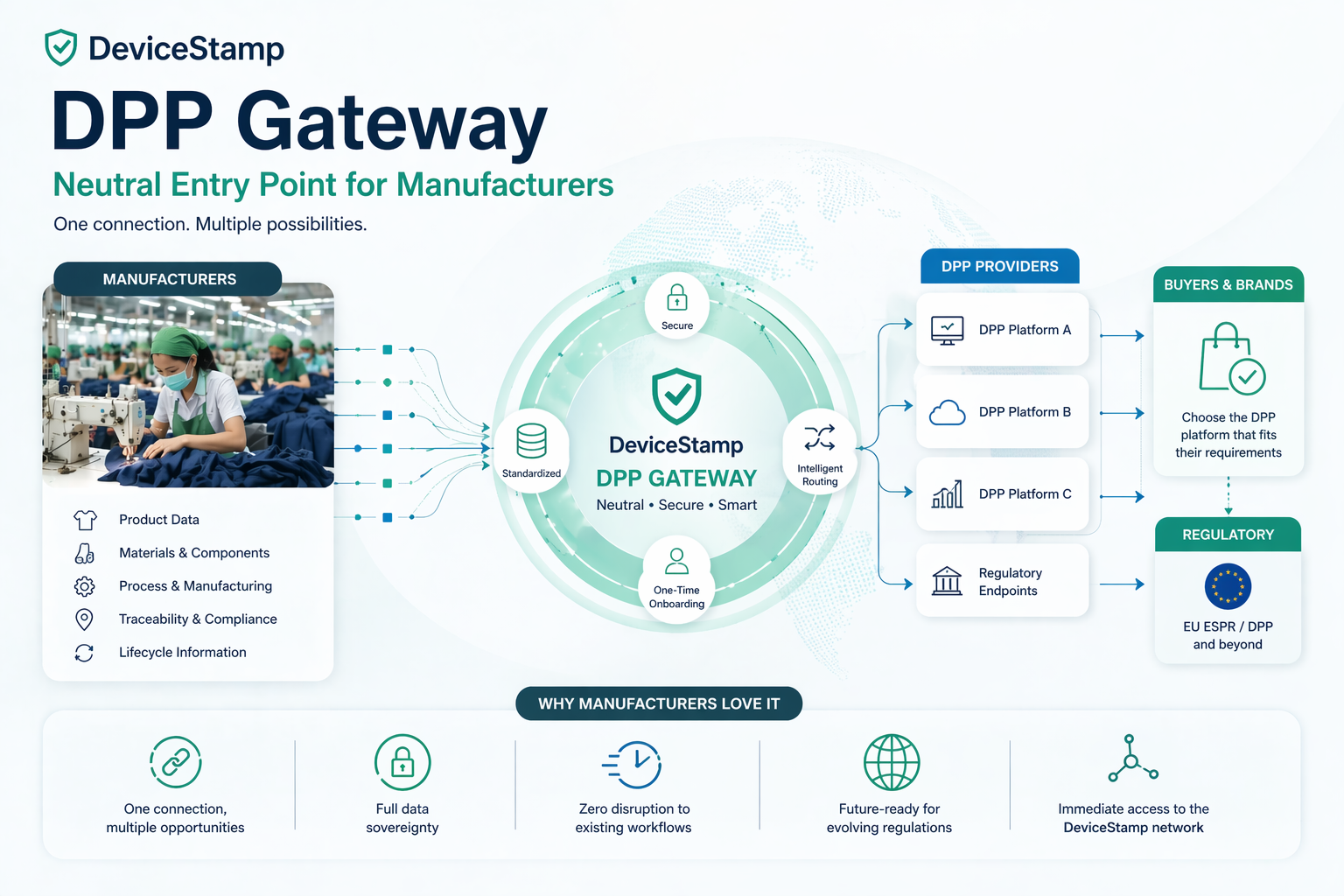
For many SME suppliers — common across furniture component and material manufacturing — maintaining separate integrations with every brand or platform is operationally and financially unrealistic. Neutral supplier-side infrastructure reduces friction by allowing manufacturers to submit structured product and traceability data once, then route approved data to multiple downstream systems. See how this works for suppliers.
Industry Segments
Different Categories, Different DPP Priorities
Residential Furniture
Consumer products where material composition, care, repairability, and spare-part information matter for longevity. Structured product data supports repair guidance, resale, and credible sustainability information for buyers.
Contract & Office Furniture
Workplace, hospitality, and institutional furniture carries extended documentation expectations across long procurement and use cycles. Product records that connect composition, certifications, and supplier data help keep that documentation usable over time.
Upholstered Furniture
Frames, foams, textiles, and leather combine in products that are difficult to separate at end-of-life. Composition and treatment data directly affects repair, refurbishment, and material-recovery outcomes.
Flat-Pack & Assembled Furniture
High-volume production and marketplace distribution benefit from serialised identity, scan verification, and synchronised component data — particularly where products are assembled by the end user from multiple parts.
Materials & Component Suppliers
Panel and board producers, hardware and mechanism manufacturers, textile and foam suppliers hold data downstream brands ultimately need: batch identifiers, composition, chemical inputs, and certifications. Structured submission of this data is the foundation of any credible product passport.
Repair, Resale & Recycling
Refurbishers, secondhand platforms, and recyclers need accurate composition and disassembly data to extend product life and recover materials. DPPs may enable resale authentication, spare-part matching, and material recovery — making the passport an operational tool, not just a compliance record.
Preparing for Digital Product Passports
Readiness Across Five Dimensions
Product-specific requirements are still being defined through delegated acts and standards work — but the operational lead time for supplier mapping, identity setup, system integration, and data governance is substantial. For most organisations, DPP readiness resembles a broader transformation of product-data architecture rather than a standalone compliance initiative.
Data & Standards Readiness
Map current product data, bills of materials, certificates, supplier records, and production events. Align product identity and data structures with relevant standards — GS1 identifiers, Digital Link, EPCIS, and emerging sector data models. Because products combine many materials and components, a shared semantic framework is what keeps supplier, brand, and regulator interpretations consistent.
Technical Systems Readiness
Manufacturers and brands may need to integrate ERP, PLM, MES, quality, certification, and labelling systems. Technical readiness involves APIs, QR printers, scan verification, serialisation workflows, product master data, and facility identifiers. Testing GS1 Digital Link early shows how product URIs, GTINs, batch data, and item-level identity work in practice.
Operational Workflow Readiness
DPP implementation affects factory and assembly operations: QR generation, label application, production-line scanning, component-to-product linking, quality-control records, and packaging validation. Piloting internal workflows with selected SKUs, suppliers, or production lines before scaling is a practical starting point.
Supplier Onboarding Readiness
With many specialised suppliers per product, onboarding is one of the most important scaling bottlenecks. Effective models need data templates, training, language support, field definitions, evidence requirements, and ongoing support — structured so suppliers provide data once and reuse it across partners.
Governance & Collaboration Readiness
DPP readiness requires cross-functional coordination across sustainability, supply chain, compliance, IT, product development, and factory operations. Organisations need data owners, escalation processes, and audit workflows — aligned with existing compliance efforts such as chemical-restriction programmes, certification systems, and product-safety processes.
Infrastructure Layer — DeviceStamp
Neutral. Seamless. Modular.
DeviceStamp is a neutral identity, verification, and deployment platform for regulated product ecosystems — helping furniture value chains connect material, supplier and product data for DPP requirements without lock-in.
Infrastructure
Identity and verification stay portable across systems. No vendor lock-in. Built for ecosystem-scale programmes.
Supplier DPP Gateway
Entry point for suppliers, routing input data to DPP providers. Enforces GS1 and other standards. Unified vendor interface across systems. No vendor lock-in.
DPP Adapter
Data sourcing access point for DPP solutions. Normalised delivery for DPP and ESG systems. Multi-channel distribution via APIs, portals, partner and ESG systems. Scales across programmes and marketplaces.
Edge Facilitator
Mobile quality checkpoint app for machine inspections. On-demand QR printing for raw materials and WIP. Real-time intra-logistics scanning. Works with existing ERP/MES via REST API.
Why This Three-Layer Model Works
Different Actors, Different Needs
Quick Orientation
Layer Overview
Supplier Gateway
Route supplier data & assign standards
Primary users: Ecosystems, suppliers
Distribution Layer
Unified access for multiple endpoints
Primary users: DPP platforms, regulators, auditors, brands
Operational Modules
Secure DPP execution modules
Primary users: Operators, integrators
Sources & References
Further Reading
This page draws on primary regulatory and standards sources. Because sector-specific requirements are still developing, this resource is maintained as a living industry reference.
Regulatory & Policy Sources
Standards & Industry Sources
Power, Verify, and Enrich Your Data Pipeline
Take Action